
TL;DR: Two firms I worked for between 2022 and 2023 — Oquant (Option Quant Inc.) and Cure Data Inc. — owe me over 500,000 SGD. Oquant’s Delaware charter had been voided since 2020 — two full years before they hired me. They paid me until February 2023, then stopped while I kept working on false promises. After every private attempt to recover the debt failed, I filed criminal referrals and civil claims in two jurisdictions. The truth always surfaces, and litigation is how you make sure it does.
Why am I publishing this?
Coming from Central Europe, I learned early: if someone wrongs you and you walk away, nobody takes you seriously again. Addressing the situation — even when the odds are stacked against you — signals that you take your reputation and your work seriously.
Litigation is the last resort. But the process itself puts truth on the public record. Smart people read court filings. The reputation of the opponent is the real verdict — even if you lose, not because of lack of argument, but because of bias or power games. The filing alone ensures the facts are permanently searchable and accessible.
The case in plain English
- Option Quant Inc. (Oquant) had its Delaware charter voided on March 1, 2020 for non-payment of taxes. Despite that, Mo Ali and Elliott Donnelley continued operating as if nothing had happened — and hired me in August 2022, over two years after the voiding, misleading me and others that the company was in perfect shape with funding secured for years ahead.
- I was paid for my work from August 2022 through February 2023. Starting in February 2023, payments stopped — but the work demands continued, and Ali kept promising that money was imminent. I worked without pay from February through August 2023, when I finally resigned.
- The fact that they paid me initially makes the subsequent non-payment even more damning — it proves they knew they owed me and had the mechanism to pay. They simply chose to stop.
- They confirmed the debt in emails, Zoom calls, and WhatsApp — but zero has been paid since February 2023.
- Under Delaware law (DGCL § 512), they are personally liable for all debts incurred while the corporation was voided. Operating a voided corporation is a criminal misdemeanour. Every contract they signed with me — from August 2022 through SOW 5 in July 2023 — was signed on behalf of a legally non-existent entity.
- Elliott Donnelley tried to erase Oquant’s debts by closing it and instantly recreating it in Canada. I have the attorney correspondence confirming this.
- Cure Data was a separate engagement — same people, same pattern, same result: zero payment.
Who is Elliott Donnelley II?
A fifth-generation member of the Chicago-based RR Donnelley family — the dynasty behind R.R. Donnelley & Sons, once the largest commercial printer in the world. Yale graduate (1988, B.A. in History).
Current roles include Founding General Partner of White Sand Investor Group (a fifth-generation Donnelley family investment partnership), founder of KD Venture Partners, Vice Chair of Synergos, and board member of the Philanthropy Workshop. He was a key advisor to the China Global Philanthropy Institute, co-founded by Ray Dalio and Bill Gates.
He is the key investor, de facto executive, and advisor of both Oquant and Cure Data — confirmed on recorded Zoom calls. He paid Oquant’s AWS bills from his personal debit card, searched for Canadian investors, micromanaged the firm, and approved all new hires — including mine in August 2022, when the company had already been voided for over two years. Mo Ali is effectively his front man.
The pattern of being listed as both “investor” and “advisor” on company websites is one he uses everywhere. According to everyone I spoke with, Donnelley has no real business achievements beyond his inherited position. In calls, rather than discussing substance, he spent most of the time talking about his parents and childhood. When challenged, his default was to tell people to “look him up.”
What is the point? Donnelley’s “legacy”
Donnelley reportedly told associates that “Oquant and Cure Data are my legacy.” Here’s what that legacy looks like:
- Zero revenue across multiple startups over nearly a decade
- Over 1 million USD owed to Delaware in unpaid taxes since 2017
- Dozens of unpaid creditors — data providers, designers, cloud hosts, former employees
- At least two people fired from their own companies because they supported Oquant and never got paid
- Repeated attempts to close entities and reopen under different names in different jurisdictions
- Hiring people — like me in 2022 — to work for a company that legally did not exist, without disclosing that fact
Is this a legacy — or a pattern that defies rational explanation? Some observers have asked what would motivate someone who can afford to pay to systematically avoid doing so — the behaviour raises more questions than it answers. Donnelley’s family net worth is reportedly 1.6 billion USD. Ali lives in an ultra-luxury Vancouver apartment with concierge and pools. Yet they refuse to pay a $20,000 web design bill or a $5,050 cloud hosting charge — let alone the salaries of people who built their products.
Who would ever work for Mo Ali after reading this? Who would invest alongside Elliott Donnelley?
Who is Muhammad “Mo” Ali?
Ali is the CEO of Oquant and Cure Data and, according to everyone I’ve spoken with who met him, is spectacularly unqualified. People in Singapore described him as “a clown,” “incompetent,” and “not trustworthy.” His entire credibility comes from access to Elliott Donnelley. The pattern — presenting himself by alleged associations rather than personal achievements — has drawn comparisons to the ‘Inventing Anna‘ story among people who observed him.
A note on Ali’s claims: it is genuinely unclear what is true and what is fabrication in anything Ali says. The scale of misinformation is so high that virtually every statement he makes should be treated with extreme scepticism. The items below are what Ali himself stated — whether any of it is true is anyone’s guess.
From documented evidence:
- Asked me to pay for his personal fitness classes, restaurant bills, and presents for his mother — all with promises to repay. Never repaid. Total: 6,363 SGD.
- Claimed his father worked for Pakistani Intelligence as a general and that he himself worked for Canadian Intelligence.
- Claimed he was court-prohibited from accessing computers in his youth due to criminal hacking. This is his own statement — like everything Ali says, it may or may not be true.
- Feared applying for a Singapore visa because of extensive background checks.
- “I cannot fly Business Class next time — too crowded. Only First Class.” While owing hundreds of thousands in wages.
- Tried to sell Cure Data’s non-existing healthcare product to Singapore hospitals.
- One of Cure Data’s own scientists responded in writing: “It looks like it, it smells like it, it is a fraud.”
Ali’s pattern of false statements
Systematic, escalating, and pathological:
- “The money is coming” — repeated monthly from February through August 2023. Nothing arrived. Ever.
- “We just got an investment of 10 million USD” — fabricated. No such investor existed.
- “Payments have been made” — Ali sent messages claiming wire transfers were initiated when no payment was ever made. Outright fabrication.
- “We have serious investors backing this for many years” — Oquant couldn’t pay a $5,000 hosting bill.
- “This month I will take care of you” — repeated every single month from February to August 2023. Zero arrived.
- “I owe you personal money. I always clear my debts.” — his own words on recorded calls. The debt was acknowledged explicitly across multiple channels. Zero paid.
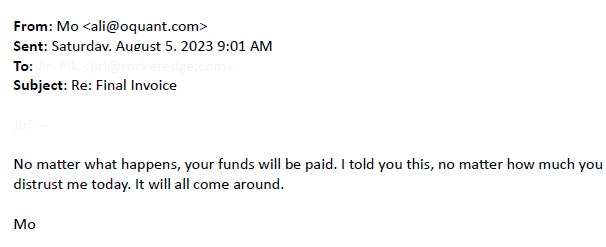
- Saurabh Joshi confirmed on August 6, 2023: “Oquant does owe you for several invoices, neither Mo nor I are disputing that.” Ali wrote the same day: “No matter what happens, your funds will be paid.”
- Ali lied to the Ontario Labour Board — claiming I did “no work for Cure Data apart from one meeting in Singapore.” Evidence shows over 10 meetings in Singapore, hundreds of emails, thousands of messages, and partnerships with NVIDIA, Microsoft, AWS, Seagate, UK Biobank, and Singapore government agencies.
- Ali’s evasion strategy: change addresses, phone numbers, email addresses, delete LinkedIn profile. The pattern of changing addresses, phone numbers, and deleting profiles is consistent with deliberate evasion of creditors.
What did Elliott Donnelley II do?
His first remark to me on a Zoom call was that I “look well-fed” — a comment dripping with contempt and designed to establish dominance.
Donnelley’s behaviour across all interactions:
- Confirmed on recorded Zoom calls that he is the key investor of both Oquant and Cure Data. Promised payments — nothing was ever paid.
- Paid Oquant’s AWS bills from his personal debit card — proving direct financial involvement and personal liability. Offered me $20,000 from personal money as a “deposit,” which I rejected — the full invoices exceeded $150,000.
- Said he invests in Mo Ali because he “loves him” and Ali must remain CEO “no matter what.”
- Threatened me: if I don’t sign up to work for him for years, all debt will be erased. An ultimatum: indentured servitude or write-off.
- Wanted to close Oquant and instantly reopen in Canada to erase debts. Their Canadian attorney advised they had to pay creditors first — so they dropped him. I have the emails.
- Claimed startups hold no responsibility for debt. He could try the same at a hotel and refuse to pay.
- His evasion strategy: threaten people with “look me up.”
- Both Elliott and Mo acknowledged their own lies — conversations included “you don’t trust me.” Correct.
The Ali-Donnelley relationship and money laundering question
The nature of the relationship is a cause of persistent speculation: Donnelley says he invests in Ali “since he loves him.” Ali says Donnelley stays at his apartment when they’re in the same city. Multiple observers identified Ali as a front for Donnelley.
Why do some commentators suspect money laundering?
- Donnelley is simultaneously investor, CEO, and advisor — the advisor role is allegedly paid. Theory: a third party invests, Donnelley cashes it out as advisory compensation.
- Mysterious alleged investors from the Middle East whose money would flow through Oquant.
- No tax returns filed since 2017 — no official record of where money went. Investment amounts don’t match expenses.
- Numerous overlapping entities with no genuine commercial intent, created and dissolved in cycles.
- A plan to close one entity and reopen in another jurisdiction — consistent with cycling funds through disposable structures.
- Donnelley’s family is worth $1.6B, Ali lives in luxury — but they refuse to pay $5,000 invoices. The economics don’t add up unless the entities serve a different purpose.
Some observers have asked whether the pattern — simultaneous investor/advisor roles, mysterious Middle Eastern investors, no tax filings since 2017, entities created and dissolved in cycles — could be consistent with money laundering. I raise the question; I don’t have the answer. The courts will examine it.
Real-world consequences
- At least two people were fired from their own companies because they supported Oquant and never got paid.
- Key employees (each owed $50K–$100K) resigned months before putting the product into production, wasting all prior investment.
- A financial data provider owed ~$24,000 — Ali went as best man to the vendor manager’s wedding, then refused to pay.
- A web design firm owed ~$18,000 — their debt collector “gave up trying to get in contact.”
- A cloud connectivity provider owed ~$5,000 — Ali ordered the service knowing he had no money to pay.
- The State of Delaware owed at least $1,000,000 in unpaid franchise taxes since 2017.
How to prevent this — lessons for everyone
This experience cost me over a year of work and hundreds of thousands in lost income. Here’s what I’d tell my past self — and anyone considering a startup engagement:
Before signing
- Check the corporate registry. Delaware’s Division of Corporations is free and takes 30 seconds. Had I checked, I would have seen that Oquant was voided — and walked away. This is the single biggest lesson: verify the legal existence of any entity before signing anything.
- Verify claims independently. “We have funding for years” is not a fact — it’s a sales pitch. Ask for bank statements, term sheets, or investor references. If they refuse, that’s your answer.
- Google the principals deeply. Search their names with “debt,” “lawsuit,” “fraud,” “complaint.” Check court records in every jurisdiction they’ve operated in. A 30-minute search could save you years.
- Never rely on a famous name as collateral. Donnelley’s family wealth meant nothing when it came time to pay. Celebrity, pedigree, and LinkedIn profiles are not guarantees of payment.
During the engagement
- Get paid before you fall behind. I was paid until February 2023. When February’s payment didn’t arrive, I should have stopped working — immediately. Instead, I believed “next week” for six months. The first missed payment is the only warning you’ll get.
- Set a hard stop-loss. Decide in advance: if payment is X days late, I stop work. No exceptions, no matter what they promise. Treat it like a trading stop-loss — it exists to protect you from your own optimism.
- Document everything in real time. Save every message, email, and call recording. Turn on WhatsApp chat backup. This habit saved me — I have thousands of messages proving every claim. Without them, Ali’s lie to the Ontario Labour Board might have worked.
- Trust actions, not words. “The money is coming” means nothing. A wire confirmation in your bank account means everything. If someone promises payment five times and delivers zero times, the pattern is the message.
When it goes wrong
- Act fast. The longer you wait, the more addresses they change, the more evidence they delete, and the more entities they dissolve. Ali switched WhatsApp messages to auto-delete in April 2023. I had backups — but if I hadn’t, critical evidence would have vanished.
- File in every available jurisdiction. I’m pursuing recovery in the US and Canada simultaneously. Each jurisdiction creates pressure and public record independently.
- Publish the facts. A website, a blog post, a court filing — all become permanent, searchable records. Professional scammers rely on victims staying silent. Don’t.
- Connect with other creditors. I discovered multiple unpaid vendors only after I started publishing. They found me. Collective action is stronger than individual pursuit.
For the ecosystem
- Startup culture has a blind spot. The “move fast and break things” ethos has been weaponised by bad actors who treat unpaid invoices as a feature, not a bug. Donnelley’s defence — “these are startups, they don’t hold responsibility for debt” — is not a legal argument. It’s an excuse for theft.
- Investors who actively participate in management are not passive shareholders. They are personally liable when things go wrong — especially when the entity is voided. If you’re an investor sitting on calls, approving hires, and paying bills from your personal card, you’re an operator.
- Regulatory gaps enable this. A voided company operated for three years, signed contracts, raised funds, and hired people — and no regulator flagged it. Delaware’s franchise tax enforcement needs teeth.
The playbook is simple: verify before you sign, stop at the first missed payment, document everything, and never stay silent.
Timeline
Active legal proceedings
Relief sought (Cure Data): USD 166,400 unpaid wages + USD 50,000 general damages + USD 10,000,000 punitive damages + interest + costs.
Claims include: breach of implied employment contract, quantum meruit, fraudulent misrepresentation, promissory estoppel, conspiracy to defraud, breach of fiduciary duty, and piercing the corporate veil.
Both cases are expected to take up to 7 years. I’m in no rush. The process is the punishment.
Available documents
Delaware Business Registry Record
20250716-EntitySearchStatusCopy_07152025Criminal Complaint
20250721-ComplaintPledge of Payment
Founders & Public Profiles
- Elliott Donnelley II – LinkedIn | Stanford Profile
- Muhammad Ali (also known as Mo Ali) – LinkedIn – the LinkedIn profile has been made private to avoid debt collectors
- Saurabh Joshi – LinkedIn
Right of rectification
If you are mentioned here and believe information is incorrect, contact me.
FAQ
How much is owed?
Over 500,000 SGD across both entities. The Cure Data claim alone seeks USD 166,400 in wages + USD 10,000,000 in punitive damages.
Why pursue litigation if it takes 7 years?
The process creates a permanent public record. Every investor or partner searching these names will find the evidence.
What is the Ontario case number?
CV-25-00748227-0000 — Ontario Courts Portal.
Jiri Pik is the founder of RocketEdge, an AI fintech company based in Singapore. Follow him on LinkedIn and X. This post reflects Jiri’s personal views. All individuals named are presumed innocent until proven guilty.
