
TL;DR: After 14 straight quarters of outflows, money returned to US sustainable funds in Q2 2026 — and roughly a third of that inflow went into one ETF that builds the electric grid for AI data centres. AI is now simultaneously ESG’s biggest customer and its biggest unanswered question. On 30 September 2026 I’m joining my Hands-On AI Trading co-authors Philip Sun and Jared Broad for a free, one-hour CFA Institute Sustainable Investing Community webinar that puts a number on that question. My part is the AI Sustainability Ledger: four columns, three numbers, one 90-day playbook. RSVP here — the sign up is available and recording goes to the community members only.
Here is the sentence I’ll open with on the 30th, and the one I expect to be argued with the most:
Sustainability is not a conscience. It is P&L you have not measured yet.
If you run or allocate to an AI trading strategy — a strategy where machine-learning models make or filter trading decisions, for example a gradient-boosted tree that decides which of a rules-based system’s signals to actually take — the environmental, governance and data footprint of that strategy is not a moral add-on. It is a set of costs. Some of them are already on your bill. Some are being priced between now and 2030. And some show up not as line items but as scarcity, refusal and correlated loss.
That is the thesis of the session “Does AI Trading Have an ESG Problem? A Practitioner’s View from Hands-On AI Trading with Python, QuantConnect, and AWS“, hosted by the CFA Institute Sustainable Investing Community. Three of the book’s five co-authors are speaking: Philip Sun, PhD, CFA (co-founder and CEO of Adaptive Investment Solutions), Jared Broad (founder of QuantConnect), and me. The full presentation will get its own post after the event. Here I want to give you the shape of the argument and the reasons I think you should spend the hour with us.
Why is a quant talking to a sustainable-investing audience?
Because the driving forces landed on my desk before they landed on anyone’s ESG report. Four numbers from 2026 explain why:
- Memory. TrendForce expected DRAM prices to rise 50–55% in a single quarter, and Micron told CNBC it was “sold out for 2026” (CNBC, January 2026). Every research loop that holds a decade of tick data in RAM is bidding against hyperscalers for the same chips.
- Capex. The five largest hyperscalers are projected to spend about US$602 billion on infrastructure this year, up 36%, with roughly 75% aimed at AI (Introl, January 2026). Compute is rationed, and the biggest buyers are served first.
- Geography. Singapore is the most expensive colocation market in Asia-Pacific — roughly US$300–450+ per kW per month for wholesale deployments, against Johor across the causeway starting near a third of that — and Johor’s electricity runs US$0.135/kWh versus Singapore’s US$0.239 (Singapore Business Review; The Business Times). Where you run a backtest is now a cost decision and a carbon-intensity decision at the same time.
- Claims. CFA Institute’s AI Washing report found firms reporting AI use in trading and portfolio optimisation jumped to 38% from 15% (CFA Institute Research and Policy Center, 2025). Far fewer disclose how. The same body’s Algorithmic Market Hypothesis names algorithmic monoculture — many firms running similar models on similar data, so they move together — as a systemic risk (CFA Institute, 2026).

Add the regulators: the Financial Stability Board opened a consultation on sound practices for responsible AI adoption on 10 June 2026 (FSB), and IOSCO published its final Supervisory Toolkit for AI Use in Capital Markets on 25 May 2026 (Regulation Tomorrow). Singapore’s carbon tax sits at S$45/tCO2e for 2026–27 on a stated path to S$50–80 by 2030 (NCCS).
None of those forces is moral. They are incentives, cost curves and rules. That is exactly why they belong in a session for people who assess ESG claims for a living: the people who sell you compute, allocate you capital, clear your trades and license your fund are already asking these questions, and every one of them is a line on your own P&L.
What’s the real reason ESG money came back?
Philip opens with two charts I found genuinely uncomfortable, and I’ll borrow the frame here because it’s the best intent investigation I’ve seen this year.
Stated reason: ESG is back. Morningstar reports US sustainable funds attracted nearly US$3 billion in Q2 2026 after 14 consecutive quarters of outflows, the first positive quarter since early 2022 (Morningstar).
Real reason: AI brought it back. By Philip’s reading of the Morningstar data, US$3.1 billion of that turn went into a single fund — the First Trust Nasdaq Clean Edge Smart Grid Infrastructure ETF — which holds companies strengthening the electric grid for AI and data-centre demand. Meanwhile the number of S&P 500 companies mentioning “ESG” on earnings calls had already collapsed from a 2021 peak, years before capital moved.
Does the stated reason hold? Only partly. Corporate language abandoned ESG about two years before capital did, and the Q2 recovery is narrow and passive-led. The money that came back is buying the power grid that AI needs. Is that ESG investing, or energy investing wearing an ESG label?
The real solution is not to argue about the label. It is to measure the thing underneath it. That is what the ledger does.
What will Philip Sun cover?
Philip takes the first 15 minutes on what AI actually does in a modern trading stack — the six-stage loop from the book: data capture, research and features, models and signals, validation, execution and hedging, risk and optimisation, with LLMs and agents running behind every stage rather than inside one box. Without giving away his slides, three of his points will change how you read the next “AI-powered” pitch deck:
- AI is a component, not a strategy. The book’s best results come from AI correcting a strategy’s decisions, not replacing them. On the book’s forex example, Corrective AI took the Sharpe ratio from 0.88 to 1.29 while annual return barely moved (3.5% to 4.1%). What halved was the drawdown. The gain came from losing less, not earning more.
- The value is unevenly distributed. Data work, hedging and execution pay well and keep paying. Signal generation — the part that makes headlines — pays least and fades fastest.
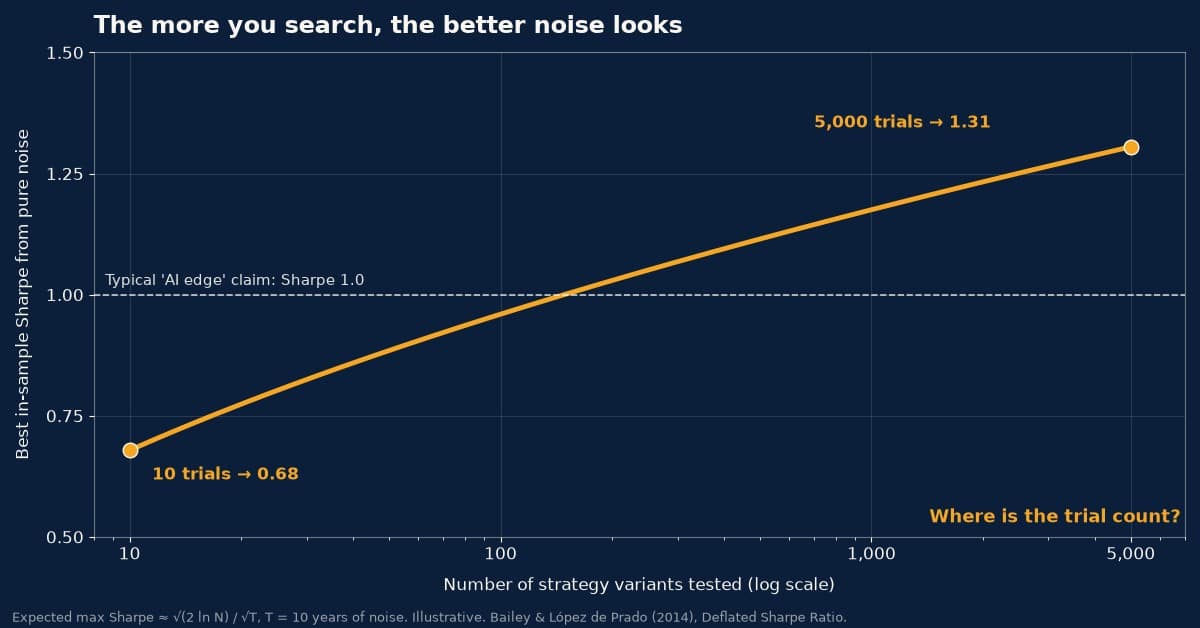
- Validation is where most AI trading stumbles. Search enough configurations and the winning backtest is a selection effect, not a discovery. Philip will show what the best in-sample Sharpe from pure noise looks like as the number of variants tested grows — and why the trial count belongs next to every reported Sharpe.
He closes with an epilogue on agentic AI — what autonomous agents achieved and breached in the last two months — and what regulators are proposing in response. One line from his deck I’ll quote now because it is the sharpest thing anyone has said about agents in finance: an agent that runs a thousand backtests overnight does not solve the multiple-testing problem. It industrialises it.
What will Jared Broad run live?
Jared takes 15 minutes to run code from the book repository live: the ML pairs-selection example and an LLM-assisted trade-research workflow, with compute, energy and cost printed alongside the P&L. No programming background required. The code is on screen so you can see what is being measured, not so you can write it. Hold the Corrective AI number from Philip’s section in your head — and watch the compute bar when Jared’s example runs.
What will I cover? The AI Sustainability Ledger
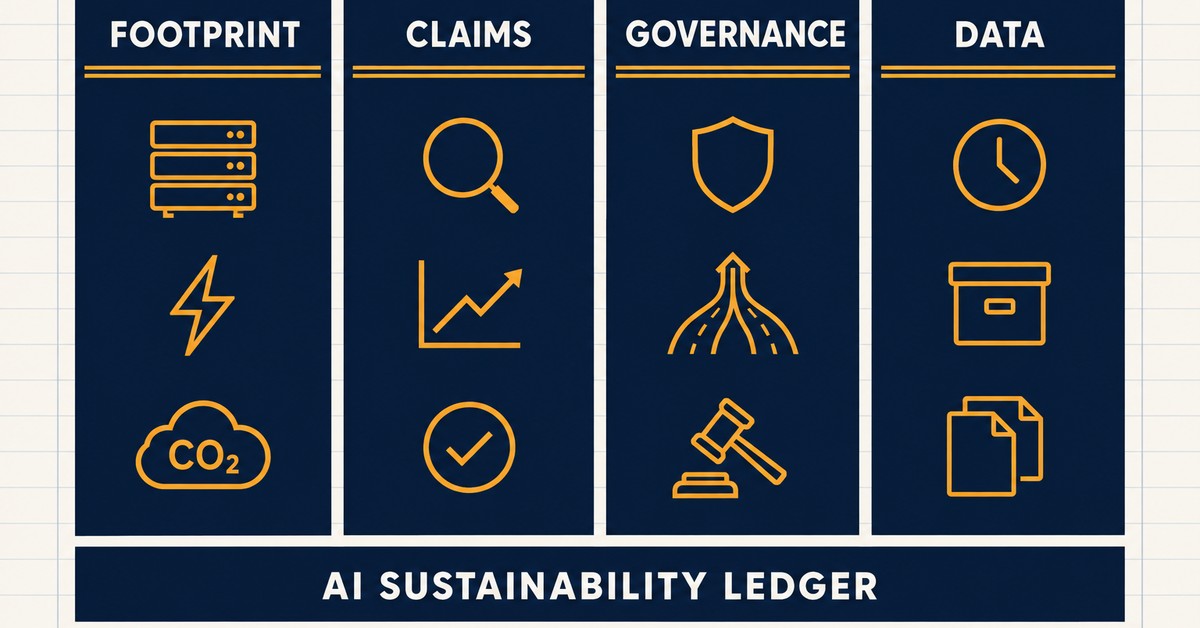
My 15 minutes turn the debate into a ledger — a four-column document a manager either can or cannot produce. That is the point: a ledger is falsifiable. A conscience is not.
Mental model: inversion. Instead of asking “is this manager sustainable?”, I ask “what would a manager who is not have to be unable to tell me?” Energy per workload, an auditable model trail and point-in-time data lineage are already answerable with tools every desk owns. Concentration of model providers, the hidden water and embodied carbon of training, and prompt provenance are still ducked. If a desk cannot answer the right-hand column, that is a diligence signal, not a moral one.
The four columns:
- Footprint (E) — dollars per signal per day, RAM per signal, CO2 per signal, silicon mix, region intensity by hour.
- Claims — what is the model, what data did it see, what proves it out of sample. All three in three sentences, or the “AI edge” claim is not a claim.
- Governance (G) — validation, explainability, and concentration with a tested fallback if the provider is rationed.
- Data — point-in-time integrity for ESG data exactly as for price data: a dead-issuer archive, as-was versus as-restated fields.
Mental model: co-benefits versus trade-offs. FinOps — the discipline of managing cloud spend as a unit economic, for example knowing your research loop costs US$X per signal per day — and ESG are cousins, not twins. Moving from Intel to ARM, halving the memory footprint, tiering cold storage: those cut the bill and the kilowatt-hours. Chasing a bigger model for a headline Sharpe, or running real-time inference for a signal that only changes daily: those raise both. A due-diligence questionnaire that measures cost per workload but not carbon per workload is diligencing half the manager.

Mental model: Jevons paradox. Cheaper compute per experiment does not mean less compute; it means more experiments. That is why the most sustainable thing a portfolio manager can do this quarter is not buy an ESG label. It is halve the memory footprint of the research loop — which also happens to be the best available hedge against a 50% DRAM shock.
Then the 90-day playbook: six moves, each with an owner, a measurable output, a FinOps saving and an ESG delta. None needs a new fund. A manager who will not do them in 90 days is telling you something about operational maturity.
The precedent: 1973, when the cost decision became the sustainability decision
Japanese carmakers did not build small, efficient cars in the 1960s to save the planet. They built them because petrol was expensive and roads were narrow at home. When the 1973 oil embargo hit, small-car sales in the US jumped to about a third of the market, and Toyota — already selling exactly that car — took the share Detroit had assumed was permanently its own (Georgia Southern University thesis on Toyota’s US advertising, 1958–1979). The “green” label arrived a decade later, and it landed on the company that had been optimising a cost line all along.
The analogy I use with clients: your compute bill is a smoke detector beeping into a pillow. It has been warning you about the same thing the ESG team is worried about, in a language the ESG team does not read. My whole session is about taking the pillow off.

What I think comes next
Three dated calls, on the record:
- By 31 December 2027, at least one top-20 allocator’s standard due-diligence questionnaire will ask an AI-driven manager for compute or energy per unit of research, not just AUM and fees. I would not have said that a year ago.
- By the time the GHG Protocol’s hourly Scope 2 guidance is finalised (expected 2027), “which region, which hour” will be a reportable fact for any fund under Singapore’s ISSB-aligned climate reporting — which means the cheap-dirty-region arbitrage stops being free.
- Within 18 months, “algorithmic monoculture” moves from the AI section of a fund’s risk report to the risk section, where correlated positioning already lives.
If I’m wrong on any of these, I’ll link back here and say so.
How to join
| What | Details |
|---|---|
| Date | Wednesday, 30 September 2026 |
| Time | 08:00 New York · 13:00 London · 14:00 Frankfurt/Zurich · 17:30 Mumbai · 20:00 Singapore/Hong Kong/Beijing · 22:00 Sydney |
| Format | Live Zoom webinar with screen-shared Python and QuantConnect notebooks. Recording available to community members afterwards. |
| Cost | Free; RSVP required to receive the calendar invite. |
| Agenda | 08:00 ET Why now (Jiri) · 08:05 What AI actually does (Philip) · 08:20 Live code, measured (Jared) · 08:35 The AI Sustainability Ledger and 90-day playbook (Jiri) · 08:50 Q&A |
Bring one thing: the most recent “AI-powered” manager pitch you have received. By the end of the hour you will be able to score it.
The book behind the session is Hands-On AI Trading with Python, QuantConnect, and AWS (Wiley, 2025) by Jiri Pik, Ernest Chan, Jared Broad, Philip Sun and Vivek Singh (Amazon); every example we reference is open source at github.com/QuantConnect/HandsOnAITradingBook. If you want the validation background first, start with my post on why LLM backtests inside the training window are memory tests and the Anti-Alpha Paradox.
FAQ
Does AI trading have an ESG problem?
It has a measurement problem that shows up in all three ESG letters. The environmental footprint is small per desk but repricing fast; the governance exposure — model concentration, unverifiable “AI edge” claims — is large and mostly unmeasured; and ESG data suffers the same look-ahead, survivorship and restatement hazards as price data. The ledger makes each one a number you can ask for.
What is the AI Sustainability Ledger?
A four-column framework — Footprint, Claims, Governance, Data — that maps AI-trading risk onto the CFA Institute standards a sustainable investor already applies. Each column ends in a specific metric or disclosure. Example: under Footprint, “dollars per signal per day, RAM per signal, CO2 per signal” — three numbers any instrumented research loop can print weekly.
What is the difference between FinOps and ESG for a trading desk?
FinOps controls the unit economics of technology (cost per workload). ESG bounds portfolio impact, governance and accountable conduct. They overlap on measured resource use — an ARM migration cuts both dollars and kWh — but diverge when a cheaper region is dirtier or a bigger model buys a headline Sharpe. Neither substitutes for the other.
Do I need to code to follow the session?
No. Jared’s live code is shown so you can see what is being measured — compute, energy and cost next to the P&L — not so you can write it. The audience is portfolio managers, allocators, ESG and stewardship professionals, and risk and model-validation teams.
Where can I find the code and slides?
All examples are open source in the book’s GitHub repository. I’ll publish a detailed walkthrough of my section — the full ledger and the 90-day playbook — on jiripik.com after the webinar.
Disclaimer: This reflects my personal views and experience, not financial advice. Past performance doesn’t guarantee future results. Performance figures quoted are illustrative examples from the book, not live trading results.
Jiri Pik is the founder of RocketEdge, an AI fintech company based in Singapore, and a co-author of Hands-On AI Trading with Python, QuantConnect, and AWS (Wiley). Follow him on LinkedIn and X for more.